5 Apr 2013

Iceland Highlights 2013 - Day 6: Svínafellsjökull & Skaftafell

After my previous night's slightly disastrous attempt at aurora-viewing and resultant late night I decided to lie in again. The weather-forecast for the morning was snowy (again), so I made another good decision - sleep is important, after all and I was already a little exhausted. After a late breakfast I headed west, where the weather was supposed to be clearer and where I could fill the car up. It was a little nerve-racking driving towards Skaftafell, nervously checking the mileage capactity on the remaining diesel in the tank, and then still having another 30km to go when the orange "empty" light came on. I passed Jökulsárlón and decided not to stop (had been there a fair bit already, after all), and continued towards Skaftafell. As I drove up a hill where the road sweeps around a big corner and heads towards the north-west I suddenly remembered that there was a petrol station (unmanned with a dilapidated hut), just before Litla Hof and Hof. I pulled in, feeling very relieved to be able to finally get some diesel in the tank (and I knew how to open the cap this time, which helped!). It was freezing cold, and snowing again, so the whole experience was rather unpleasant. I put in the amount I thought I needed to fill the tank up and the total came to far less than that, so hopefully they only charged me for what I used, and not the full amount!

Feeling much less stressed I continued on and decided that Svínafellsjökull would be my first stop. There was patchy sun by now, once I'd turned inland. I'd had a beautiful experience the previous year on my only vaguely sunny day where I sat at the edge of the glacier waiting for a layer of fog to clear, which it eventually did. I was a bit late in the day for the best light, and my luck with the sun and clouds wasn't great. I stopped along the track on the way to the glacier and caught a glimpse of sun and a tiny reflection of one of the mountains above.

Once I reached the parking area the glacier looked a bit dull and the mountains looked uninspiring against a backdrop of white cloud. I climbed along the path to the left-hand side of the glacier for a bit, to where I'd got the magnificent view the previous year and waited for the light to improve. The sun shone through the clouds from time to time, giving some great crepuscular rays.

A closer look at the ice through a zoom lens revealed that it was coated with a light covering of snow or hail.

 As I sat looking at the glacier, waiting for the sun to reappear, I noticed a couple of photographers down by the lagoon at the foot of the glacier. The lagoon the previous year had been almost empty of icebergs, but this year it was full of them, so I decided I'd follow their lead and go and investigate from the shore-side.


As I passed over the mounds of terminal moraine to get around to the far side of the lake I met the photographers - it was the same two I'd met in the café the previous day. They warned me about slight quicksand in the muddy shores of the lagoon, but my wellies served me well and barely sank in at all. At the edge of the lagoon large icebergs were piled up high on the shore - a storm had obviously pushed them higher recently. I was able to walk between some of them, although I felt a bit nervous as some were dripping and creaking as I passed by. Again, apart from the two photographers, no-one knew I was there, so I needed to be a bit careful! The light was getting worse, heading towards midday and a large bank of cloud had come overhead, so the icebergs didn't look their best. I continued around as far as I could and marvelled at some of the shapes that had been carved on their journeys. The dynamic range between the blue and white sky and the icebergs in shadow and light was enormous, so I played around with the HDR setting on the camera. The in-camera option didn't produce nice results at all, so I'd have to do my best in post-processing. In the end I had the most luck with just one photo, with a bit of dodging and burning. The iceberg looked a bit like the underside of a humpback whale to me.


The sun came out at one point, so I raced around the side of a few icebergs to capture a wonderful triangular one I'd seen earlier on. It looked so much more dramatic with the sun shining on it!


Eventually I tore myself away from Svínafellsjökull as nearby Svartifoss beckoned, even though the sun had returned. I had beautiful views of the muddy face of the glacier as I clambered back over the moraine and back to the car. Two coach-loads of English school-children had just arrived, so it was a nice time to leave; hopefully that meant that Svartifoss wouldn't be as crowded. What a great place for a school geography field-trip.


The couple I'd spoken to in the guesthouse had told me that Svartifoss had a lot of ice around (and that the bridge across the river had been rebuilt), so I knew it wasn't going to look as it had done the previous year. I parked the car at the entrance to the Skaftafell National Park and headed up the hill, working up quite a sweat in all my gear. The falls did, in fact, look very different from my previous trip. The light was different, the water volume was tiny, the river was completely covered in snow, the waterfall landed in a snowy chimney, and huge icicles hung from some of the basalt columns.


The columns were mostly dry too, and looked as if they were covered in salt. The regularity of their hexagonal shape just blew me away (again); sometimes nature leaves me speechless!

My hands were suddenly exremely cold and after a quick chat with an American photographer (the only other person there, thankfully), I headed across the bridge, up the hill and then wandered back down to the car, enjoying the afternoon sun, now the sky had cleared. A few peaks in the distance were visible now most of the cloud had gone.

Obviously by the time I'd driven back to Jökulsárlón (around that point at which the weather always seems to change) the skies had clouded over. It was my last evening in the area, so I had to give the beach another visit. There was a brief glimpse of sunset, that I shared with a number of other photographers on the beach, before it quickly darkened again.


I got home after a long day to an email from the ice cave guide that the trip was back on for the following morning. The skies were completely covered in cloud again and the aurora forecast was quiet, so no obsessing about it for another night. I skyped the hubby, finished off the last of the wine and set my alarm for 5.45am, which would give me time to get up to see sunrise over the beach (just one last trip!), head back to grab breakfast, pack and check out and then drive to the petrol station to meet the guide. Another great day in Iceland was over.

Click here to see Day 7: Jökulsárlón back to Vik

Iceland Highlights 2013: Day 5 - Jökulsárlón, Jökulsárlón, and more Jökulsárlón

I just love this place. Well, I love the beach. Oddly the lagoon just doesn't really do it for me. But the beach is a different matter and has become something of an obsession...

So, I didn't bother with an early start for sunrise as the weather-forecast had been for total cloud cover (and probably rain or snow too). A couple I met in the guesthouse had got up at the crack of dawn and confirmed that I'd made the right decision. I had a nice chat with them for a while before setting off on the short journey to Jökulsárlón. I thought that I should give the lagoon a chance; it is, after all, the place that everyone raves about and has been used in various films, blah blah blah. Just like last year, the weather was "changeable" - with mostly grey clouds, but a spot of brightness over the glacier to the north. I headed along the beach, noticing how few icebergs there were in the first bit of the lagoon. A few seals swam around, their round nostrils giving them away as they eyed me up.

I started off shooting without any filters, but I just don't like the look of normal water any more (generally), so it was on with the filters pretty much straight away!

Water with lots of little icebergs in doesn't actually lend itself to long exposure either, though, as they can end up just looking blurred. I eventually found a rather nice iceberg in the shape of a heart, with a small pile of pebbles, but it was moving around in the slight swell of the lagoon, so it was off with the filters briefly for a 1/60th of a second shot.


I wasn't really finding the place very inspiring, and it started to snow quite heavily - a cold wet snow accompanied by a biting wind - so I gave up and headed into the café for a break, leaving my cold, wet camera in the car to prevent any condensation issues from the warmth of the café. Inside I treated myself to a lovely piece of apple tart and a coffee and sat chatting to a couple of fellow photographers, who were also taking a little break from the weather and had already been out there for a couple of hours too. Within minutes the snow had stopped and the sun came out, but I didn't have the energy to go back out just yet.

Next stop was the beach again, my favourite spot. I got down to the beach - the weather now much brighter, with some cloud definition - to find it littered with tiny pieces of ice as well as some bigger bergs, as well as about 10 other photographers. The sun even made a brief appearance. My plan was - again - to try to capture water trails from the icebergs, after a wave has washed over them. I've written another blog about this in more detail, but here are a few of my results from the afternoon.


After a couple of hours I thought I should probably have a break, given that my toes were frozen, my memory card was filling up fast, I'd already got through one battery and I was a bit iceberged-out. I headed back to the guesthouse for a rest and a sandwich, and then headed back to the beach for sunset. The weather wasn't great, but there was still some definition in the sky. The odd snow and hail shower were still drifting around, hitting the beach when I arrived.


I stayed until the light disappeared and the nearly-full moon appeared in its place, before heading home to check the aurora and weather-forecast, rustle up an easy pasta dish and download and review the day's shots.


The short-term aurora forecast was pretty active for the evening, but it was snowing outside on and off and generally pretty cloudy. I decided that I had to go and give it a try though, as the weather-forecast was better towards Skaftafell (63km away). I was running low on petrol, so decided that a combined aurora and petrol-filling trip would be a good idea, so headed out at about midnight. I got about 20km, just the other side of Jökulsárlón, when I decided it was a really bad idea after all. There was a heavy sleet accumulating on the road, and I suddenly thought "what if this settles all night and then the road's impassable on my return at 2am?" No-one knew I was even out there. I stopped the car, took some photos of the cloudy sky (to make sure that there were no lights lurking - there weren't) and then turned round and headed home. I'd still have enough petrol to make it back to the gas station the following morning with a little to spare. I got home and had a large glass of wine and felt relieved that I'd made a sensible decision. No aurora seen, but at least I was warm and safe!

More shots of the ice can be seen on my website!

Click here to see Day 6 - Svínafellsjökull & Skaftafell

4 Apr 2013

Iceland Highlights 2013 - Day 4: Drive from Vik to Jökulsárlón

I planned to spend a couple more nights in Vik on my way back, so headed to Jökulsárlón on my fourth day, where I had booked three nights in a lovely guesthouse not far from the lagoon and beach. I was rather excited to see those little blue bergs on the beach again!


I had a few stops planned along the way, including my favourite Icelandic mountain, Lómagnúpur. I'd book a guided trip to an ice cave, so had to be at the petrol station at Svínafell at 3.30pm, which gave me a good few hours to make my way there with a few stops en route. When you're doing a return trip it's very easy to say to yourself, "oh, I'll stop there on the way back", but now I know from experience that if you see something you like and the weather and light is half-decent, then you must stop, as the weather is bound to be crap on the return trip if you don't (especially in Iceland, in winter)! So, I always try to leave enough time to be able to make those stops on the first leg of the journey.

I left Vik in what I'd learned to expect as typical weather - a strong wind and a hailstorm. I hadn't bothered to get up for "sunrise" having a hunch that there wouldn't be one. I was glad for the extra sleep. I had to stop to fill the car up with Diesel before I left Vik but couldn't work out how to open the petrol cap. Feeling like a complete idiot I went inside to ask a guy to help me. I felt even more of an idiot when he said "you just have to put the key in it" - I hadn't even noticed the key-hole in the top of the cap! Poor man went back inside, covered in hail.

Off I set, and as usual did a couple of detours along the way. Just outside of Vik is a huge free-standing outcrop, called Hjörleifshöfði, which appeared dramatically as I approached, partly shrouded in cloud and mist. I drove towards it and met another 4WD coming towards me and stopped to take a few snaps, before the hail got the better of me. Just as I was about to leave I heard the telltale sound of a gaggle of whooper swans and managed to get a couple of shots (although didn't have the zoom on). I was pretty confident I'd see many more further east, as I had seen dozens of them the previous year.


The weather along the way improved a little, with patches of blue sky visible from time to time, but I kept stopping to take photographs of the rain in the distance to the south - I just love being able to see it falling (away from me!).

There are quite long stretches of road in Southern Iceland where you cross sandurs, which are huge glacial outwash plains. Mile after mile of black sand is criss-crossed by braided streams that carry the glacial meltwater down to the sea, together with silt and other debris. The road often meanders, where a temporary diversion has been built while they re-build the existing bridge that has been washed away or damaged during heavy flooding. Sometimes katabatic winds can cause sandstorms harsh enough to strip the paint from your car. The weather wasn't that bad on my journey, and eventually the scenery changes and there's some other geological feature to catch your eye. Just before getting to Kirkjubæjarklaustur (a bit of a tongue-twister of a name; not the only one) you pass through a section of rounded lava mounds covered with green moss. As I drove through the lava field it had just been covered with a light snow or hail.


Next stop, I planned, would be a nice little geological feature at Kirkjugólf, where the tops of about fifty basalt columns sit together in a field, just on the other side of Kirkjubæjarklaustur. Apparently the locals had thought it was the floor of an ancient church (Kirkjugólf literally means "church floor"). I'd visited on my last trip, but the weather had been overcast. The weather this time was so grey that I decided to ignore my own policy and give it a miss, hoping for the best on my return (the snow/hail and wind weren't letting up), so carried on straight through the town and continued my journey eastwards, excited to see the towering Lómagnúpur again, weather-permitting.

I soon passed the sweet little waterfall Foss á Siðu, which barely had any water flowing. The wind is renowned for taking the water in all sorts of directions, including upwards, and sure enough the water wasn't going straight downwards when I drove past.


My next stop was completely unscheduled, and something I hadn't noticed on my previous trip (the weather driving that day had been far, far worse!). I came around a corner, up a slight hill, and noticed some very picturesque shallow waterfalls nestled beneath a small mountain shelf. The sun even deigned to come out for me, as I played around with different filters and exposure times. I can't find a name for these falls on a map, but here they are, shot at 0.4 seconds exposure length.

So I finally reached Lómagnúpur, and turned left on a little gravel road raised above some small pools below. I parked in the one pull-out area, where I stopped last year, and headed down the bank, armed with camera and tripod. Most of the little pools were covered in ice, so there was no chance of a reflection shot, as I'd got last year when the sun gave me a small glimpse at the right moment. The cloud did clear a little this time, and I could see the mountain, so I wasn't complaining too much.


My date with the ice cave guide was beckoning, so I didn't hang around this mighty mountain for too long. The next stretch was across another wide sandur, although it was broken up by some black sandy mounds covered with reeds. The rain and wind returned, so no more stops until I reached Svínafell. I was a little early so I headed up to Svínafellsjökull and sat in the car eating my lunch. A few people came, walked up to the viewpoint in the hailstorm, ran back to their cars and disappeared. I had a little snooze, hoping the weather might clear up. No luck, so I snoozed some more and then headed back to the petrol station to meet the guide. 


I met the guide's son (also a guide) and got my gear ready, while we waited for two other people to arrive. Fifteen minutes later and there was no sign of them, so the ice cave trip was off. I told him that I was around for a few days, hoping that I might get another chance. Rather disappointed I continued on my last 50km to Jökulsárlón, but at least I had that to look forward to, and the hail had finally stopped.

Last year I'd discovered another glacial lake, Fjallsárlón, about 8km from Jökulsárlón, which was very picturesque too, but completely empty of other people (not another photographer in sight!). I came to the turn-off and drove up to the end of the road, and traipsed down the hillside to the lake. It was completely different from last year, with the lake mostly frozen and huge icebergs piled up against the shore (again, no chance for reflection shots of the pointy peak in the background). I noticed one iceberg that showed part of its underside - an incredible shade of blue.


I didn't stay too long, thinking I'd be returning, as I had two whole days in the area, and the draw of the icebergs on the beach at Jökulsárlón was too much to resist. I felt as if I knew the road pretty well, having driven up and down it a few times the previous year - for sunrise, for sunset, etc.. When I saw the small suspension bridge looming into view I knew I was there, and after crossing the bridge I immediately turned right towards the beach on the far side of the shore - my favourite spot the previous year. I got my gear together, wrapped up warm (it wasn't raining, snowing or hailing, but was still pretty nippy) and headed over the ridge to the beach. I was a little confused at first, as there were not only no other people there, but no icebergs either. For a moment I felt devastated, but then a quick glance back to the other side of the river onto the far beach reassured me that there were not only many icebergs to be seen, but plenty of other photographers too! Back in the car, nipped across the bridge, then down to the busy beach to begin my quest to capture perfect waves trails over icebergs!

As I'd found on the previous trip, the icebergs were so different on each visit, depending on the tides, the waves and what the glacier had dumped into the nearby lagoon. On this occasion there were some large blue icebergs, but not many small fragments, so my trail idea was out. I got a little fixated on one big berg (among others) that looked a bit like a (blue) horse's head, lying in the breaking waves.


Eventually I dragged myself away, with no sunset to look forward to, as it was getting greyer by the minute. I arrived at the lovely Hali guesthouse a mere 13km away and got the same lovely little room as the previous year. I ate a delicious locally farmed artic char at the restaurant, then headed back to my room to look over the hundreds of photos I'd taken and obsess, as I did each night, about the potential for northern lights showing that night. The auroral activity was low, and there was thick cloud-cover, but I still checked every five minutes to see if there was going to be any change. The weather-forecast didn't look too good for the morning either, so finally I opened one of the bottles of wine I'd bought at the duty free shop on arrival and set my alarm for a nice sociable 8.30am.

Click here to see Day 5: Jökulsárlón, Jökulsárlón & more Jökulsárlón!

3 Apr 2013

Iceland Highlights 2013 - Day 3: Drive from Reykjavik to Vik

The following morning I set off from Reykjavik, heading east; my destination for the evening was Vik, about 190km away. The weather was lovely, with pretty clear skies for most of the day. I stopped at Kerið, a volcanic crater lake on the road towards Gulfoss, but unfortunately the sun was a little low in the sky, and it was covered in ice, so I was unable to appreciate the colour that one sees later in the year (a bright blue/green). I had a little hike around the crater and then down to the water's edge (which was all ice) before heading back on my journey to Vik.

From Kerið to Vik there doesn't appear too much to stop at along the way, apart from a couple of impressive waterfalls, but I was pleasantly surprised! Straight after rejoining the ringroad I passed through the town of Selfoss. As I crossed the bridge into town I noticed a striking church on the banks of the icy river, so pulled over to take a shot.


Heading further east I passed lots of interesting geology (you can't travel anywhere in Iceland without seeing cool scenery), and took a turning off the road to the north, to explore a little. The mountain ahead of me was Hekla, which has become a little active (near the end of my stay I was hoping that there might be some action that would strand me there to take more photos, as there had been some ominous earthquakes, but no such luck/bad luck!) At the end of the road I stopped, played catch with a dog that presented me with a lump  of volcanic rock to throw, and stopped to enjoy the view below along the road on the way back to the ringroad. For such a rugged country there are some remarkably picturesque spots too.


Onwards on the last stretch of the journey towards Vik, the sun still shining, and I finally arrived at the first of the two spectacular waterfalls, Seljalandsfoss. I sat on a bench in the sun, drinking some Skyr yoghurt, eating a rye bread sandwich. As I ate the sun was coming around the side of the hill and onto the falls. I was quite surprised at how much ice there still was, as I'd visited on the exact same day the previous year and it had been completely ice-free (and this was also supposedly a much milder winter). I climbed the snowy steps on the opposite side of the falls, getting covered in spray and worrying about slipping in the process. When I got back down and cleaned off the lens and filters the sun was completely on the falls, producing a beautiful rainbow. It doesn't get much better than that!


And the ice formations on the far bank were unlike anything I'd seen before too; they looked like hundreds of grey and white eggs.

Next stop was another waterfall just around the corner (about 30km away) - Skogafoss. The sun was in the wrong place (I was about an hour late), but it was still impressive. I tried to recreate an atmospheric shot I took the previous year, but without the mist and rain (and blue anorak) it just wasn't the same.


From there it was only 30km more to my destination. The sun was quickly disappearing and I wanted to get to a beach near Vik for sunset, but I also wanted to get to the hostel to make sure I got a lower bunk-bed! Sunset took priority (it was only for one night, after all, so a top bunk wouldn't be the end of the world), so I drove to Reynisfjara first, a beach I'd visited the previous year that is on the other side of the headland from Vik, from where you can see a couple of the stacks off the coast, and where there are some beautiful basalt columns. It was a beautiful evening, with very little wind for a change. On my previous visit the winds had been so strong that I couldn't even use my heavy-duty tripod and the car kept getting whipped by the wind (and the beach was a couple of metres higher too)!

I sat on the beach, tripod firmly sitting there without being blown away, and watched the sun dip beyond Dyrholaey at the western end of the beach and the lovely golden light on the basalt columns to the east.


After a beautiful sunset I drove around the headland and into the picturesque Vik and to the cute little Nordurvik hostel where I found there was still a lower bunk available! Apart from a French party who'd stunk the hostel out with some fried fish and a headache from dehydration, as well as the skies clouding over stopping any chance of northern lights, it had been a fantastic day, with more sunlight than I'd had during my whole trip the previous year. If only those skies would stay clear and those aurora make an appearance...

Click here to see Day 4: Vik to Jökulsárlón 

Iceland Highlights 2013 - Day 2: Reykjavik

I recently returned from my fifth visit to Iceland. I had planned to write a daily blog as I went along, but what with all the early mornings hoping for decent sunrises (got a couple) and late nights hoping for northern lights (barely a glimpse) as well as days full of driving and photography, I really didn't have the time or energy.

So I'm putting together a collection of my favourite places and photographs from my nine-day trip. I did a similar trip last year, but took in the Snaefellsnes Peninsula in the west as well. This year I decided to concentrate on the southern coast, starting in Reykjavik and going as far east as Jökulsárlón, which allowed me more time in Jökulsárlón and Vik, and a lot less driving.

Reykjavik is a wonderful little city, full of amazing architecture and sculptures. My favourite sculpture, and probably the best known is the Sólfar, or Sun Voyager, by Jón Gunnar Árnason. I stayed very close by which was convenient for nipping down there to capture it under different lighting conditions. I think it looked the best during the sunrise of my first morning there, although it seems to look good in any light.

I spent the morning having a little wander around the chilly town, stopping for some porridge and fantastic coffee in Kaffismidjan (reputedly the best coffee in Iceland, and comes personally recommended), taking in the mighty Hallgrimskírkja and wandering around the atria in awe at the recently-built Harpa. I didn't realise that you can actually go into the concert hall too - will have to take that it on my next visit.


I was a little rushed as I'd arranged to meet my friend JP and join him for a walk along the coast with his pack of cocker spaniels and labradors. He lives near another amazing sculpture-park out on Grafarvogur, with wonderful views across to the Snaefellsjökull mountain on a clear day.

After a spot of lunch and a quick trip to a Bonus supermarket to stock up on provisions for the week it was back to the apartment, Sólfar for sunset (it had clouded over by this point) and then manicly checking the aurora and weather forecast for northern lights. I went out for a rather disappointing noodle dish in a fast-food joint (wasn't feeling well so the thought of chicken noodle soup appealed, sadly it didn't quite live up to expectations!). Later on I popped down to the harbour when the aurora forecast was "active", but only got a glimpse through pretty dense cloud-cover. As it happens, they were barely perceptible to the naked eye, but with an 8-second exposure I could actually see something!

The ambient light from the city didn't help, but I didn't see any point in getting into the car and driving out to somewhere dark if all I was going to see was cloud anyway (and it was getting cloudier - not to mention colder - by the minute). Besides, I had plenty of further opportunities to see those elusive lights (or so I thought!).


19 Mar 2013

Iceland March 2013 - Day 1

Finally I am in Iceland again! It always seems to take far too long to get here, considering it's only a 2 hour 40 minute flight away, but it's definitely worth the journey. As usual I was greeted by buffeting winds, which have brought the outside air temperature down to "excrutiating." I picked up my rented car, drove the rather dull and familiar route into the city, found my apartment (same place as last year - very easy), then immediately headed out to capture the Sun Voyager sculpture at sunset, wrapped in an inadequte layer of down (note to self: full thermals under everything from now on!).

I then had a quick drink with my friend JP, a fellow cocker-spaniel owner, before having a tasty little bite to eat in Café Sólon, washed down with a local IPA. I passed a lovely pair of sculptures; I'll have to investigate a bit more in the morning.


The forecast for the northern lights is low (ie. some activity), but there's too much cloud covering the sky to see anything; will have to cross my fingers and hope for another solar event like the one that gave the locals a good show on the two days prior to my arrival! So off to bed for a relatively early night.

2 Mar 2013

Why I Love Long Exposure Photography

Lots of people love it. Lots of people hate it. I'm one of the former.

Long exposure is a technique that seems to bring out mixed reactions in people, in the way that the use of HDR and some other photoshop methods do too. Sometimes it can seem as if every image of water has used it - that milky look is everywhere! It doesn't look very natural; it doesn't represent what the eye sees. However, used in the right situations it can make the appearance of water far more pleasing to the eye. It can make clouds look far more dramatic, stretched across the sky. It can bring a dreamy look to a shot that would be a bit dull if static. You can get rid of people in a busy street, or create interesting movement blur. Light trails can stretch across a night or dusk shot. During daylight hours, it's usually only possible with the help of a filter or two.

I started to use neutral density (ND) filters a few years ago - beginning with a graduated one to combat too-light skies and too-dark foregrounds, and eventually moved on to quite dark ND filters that have enabled me to produce long exposure shots. My collection has grown, and I now own the ND graduated one, and three pieces of what's sometimes called "black glass", varying in their blackness. The first one I got is probably my favourite - the B+W 10-stop ND filter. This allows me to shoot for 30 seconds or more in broad daylight and capture moving clouds and smooth water. I found it a bit restrictive (too dark sometimes), though, so added a 6-stop and eventually a 3-stop to my collection, allowing me to have more control over the creative process (more aperture/exposure length combinations were now possible). Occasionally I'll combine a couple of the filters to create an even longer exposure, or something inbetween what each one would allow on their own. I also use a circular polarising filter, which can also have the effect of reducing the incoming light, allowing slightly longer exposures again.

Below are a few examples, comparing normal shots with long exposure shots. The first pair was taken just after sunset in the Cairngorm Mountains in Scotland at the end of April 2011. The first shot was a 2-second exposure (not exactly short, but not that long either), just using the graduated ND filter. The second shot is a 52-second exposure, using the graduated ND filter and the 10-stop filter. They're both taken at 10mm on a cropped-frame camera, and I had to crop the shots as there was a bit of the edge of the filters showing (you cannot shoot that wide when you have filters stacked at the front of your wide-angle lens).


This was the first time I really got to play around with the 10-stopper and I loved it! My opinion is that the second image looks far more atmospheric and pleasing to the eye. As the water was still, there's not a great deal of difference there, so most of the effect is in the clouds. We camped just next to this little lake, and I almost got hypothermia in the process of taking a long series of similar shots (always wrap up warm when taking time-consuming long exposure shots outdoors - especially in Scotland in April).

In the second example, the big difference is in the appearance of the waves. These shots were taken at Jökulsárlón beach in south-east Iceland, in March 2012. The black volcanic sandy beach is littered with icebergs of different shapes and sizes that drift into the sea from the nearby lagoon, at the head of which is a calving glacier. The first shot is a 1/50th second exposure (pretty quick!) and the other is taken with the 6 stop ND filter (I think - I didn't write down which combination of filters I used for each shot) and is 3.2 seconds long. Personally, I think the 3.2 second exposure is much better, even though there's no impression of the strength or power of the waves. It just looks nicer to me.


Waterfalls are a prime subject for long exposures. At normal exposures the water is captured in motion (in fact to get a waterfall really sharp you need an incredibly fast shutter speed - not always possible if there's limited light otherwise). Slowed down just a little results in a nice smooth line of water. Again, whether you like it or not comes down in part to personal preference. This example is from Svartifoss, also in south-eastern Iceland, taken in March 2012. The first shot is 1/50th second exposure again and the second is 4 seconds long. I think I prefer the longer one, although actually I'm not completely sure on this one. This is why I always take some without the filters on, to ensure that I capture the shot firstly as I see it, and then with the creative twist, to see which one I prefer.

  
Long exposure doesn't work in every situation, especially if there are moving things, like tiny bits of ice floating, or trees moving, which can end up just looking messy. Sometimes this can work - reeds blowing in the wind look good, for example, but sometimes it doesn't. It's not a science, and that's another reason I like it - playing around with the different effects is interesting and fun and the results can be surprising.

There are a few things to bear in mind when taking long exposure shots that I thought I'd end with.
1) You must have a tripod, or something secure to rest your camera on. I also use either a remote shutter release or a 2-second timer delay. Any camera shake will blur the otherwise-sharp surroundings. You might also want to set the mirror lock-up, but I haven't found that this makes a difference.
2) Some filters produce a slight colour-cast. As you can see in the waterfall example there is a slightly pink hue. Sometimes with the B+W 10 stop this is extremely noticeable. I can usually correct this by adjusting the white balance, but sometimes it's quite difficult to get a realistic colour!
3) Always shoot in RAW, so that you can do the adjustments to white balance, exposure, etc. 
4) If you've got stacked screw-in filters on a wide-angle lens, you probably won't be able to shoot at your widest, as the filters will show in the far corners. Try to buy filters that are as flat as possible (the B+W ones are fairly flat, but cheaper ones aren't!).
5) You may need to check the results for hot/dead pixels (during post-processing) and use a stamp/clone tool to remove any. These may be white or coloured. On my last camera - the Canon 60D - I had lots of these (white, blue and red), and the longer the exposure, the more I could see. It was also worse at higher aperture settings. I haven't done a great deal of long exposure work with my Canon 5D Mark III, but I'm hoping it won't be as bad, as it can be quite time-consuming to have to do this.
6) Make sure your sensor is clean. This is an obvious one, but I overlooked this before I went to Iceland last year. As a result, anything with an aperture of over about f/8 (ie. all my long exposure landscape shots!) will show any dust on the sensor as a round grey splodge on your shot. Again, mostly these can be removed using a stamp/clone tool, but it's a real pain. I had dozens of them on my shots from Iceland in 2011. It resulted in me researching about cleaning the sensor and investing some time and money in finding a solution (check out this article (point 10) for advice on this!).
7) Buy the best filters you can afford. They come in screw-in ones like the B+W, or square ones that need to be attached with a clamp. I went for the former option, mainly because I bought one round one and then didn't want to invest in a different system! Think about which might suit your way of working. The screw-in graduated ND filter is not ideal, as you cannot alter the place in which the dark ends and the clear begins - it's bang in the middle. You can twist it round easily, but if your sky's taking up 2/3 of the shot then part of it will be darkened but not all of it. With the clamp system then you can mount it at the right place according to where your horizon is. Some of the filters are seriously expensive (I think the B+W 10-stop was about £120), but they do vary from seller to seller, so it's worth shopping around. They come with varying different coatings, some of which are supposed to last better than others; this also affects the price quite dramatically.
8) Play around with a combination of different filters to get the right exposure length/aperture for the shot you're looking for. If you have screw-in ones and they get stuck, try rubber gloves to get them off (see this article for advice on this!).
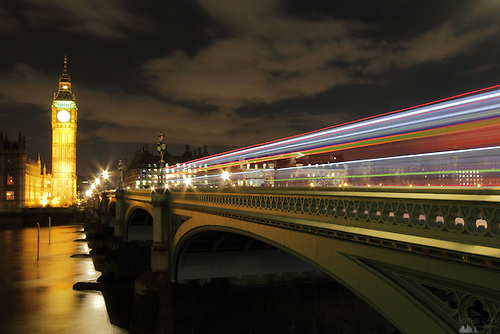
9) As it gets darker you will need less glass and longer exposures. By dusk you probably won't need any filters, or maybe just a couple of stops, depending on the effect you're after (see image below, taken without a filter).
10) Use the bulb function if you need to take photos of longer than 30 seconds, and use a remote shutter release button.
11) Have a play around with different aperture/exposure length settings. I usually shoot in aperture priority (AV) mode, but if I'm doing long exposure shots I might use the time priorty mode (TV) or completely manual. Some people have produced tables about what settings you need to use, but I prefer trying a few out to see what I like. It can be quite time-consuming though.
12) Wrap up warm - it can take a long time to take these shots.
13) Go alone - taking long exposures is quite an anti-social habit. I now have to go on photography trips on my own ;)
14) Don't get completely carried away! Take some normal, filterless shots too. It's good to be able to compare the difference to see which you prefer. Plus it's far more sociable if you're with someone.

There's a great article by Peter Hill with loads more detail on ND filters, which helped me get the hang of it to start with - really worth having a look.

For more examples, have a look at the Long Exposure Gallery on my website. And let me know if you have any additional tips or comments!